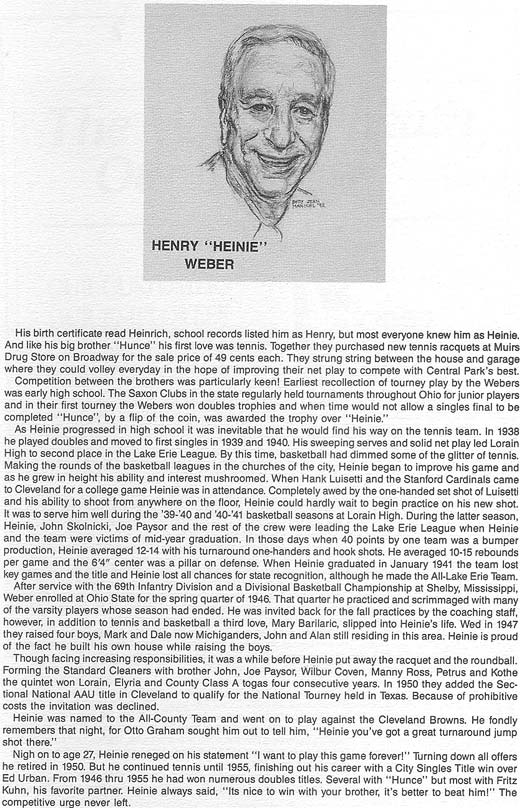
Weber, Henry “Heinie”

Henry “Heinie” Weber – (1992)


HENRY “HEINIE” WEBER

His birth certificate read Heinrich, school records listed him as Henry, but most everyone knew him as Heinie. And like his big brother “Hunce” his first love was tennis. Together they purchased new tennis racquets at Muirs Drug Store on Broadway for the sale price of 49 cents each. They strung string between the house and garage where they could volley everyday in the hope of improving their net play to compete with Central Park’s best.

Competition between the brothers was particularly keen! Earliest recollection of tourney play by the Webers was early high school. The Saxon Clubs in the state regularly held tournaments throughout Ohio for junior players and in their first tourney the Webers won doubles trophies and when time would not allow a singles final to be completed “Hunce”, by a flip of the coin, was awarded the trophy over “Heinie.”

As Heinie progressed in high school it was inevitable that he would find his way on the tennis team. In 1938 he played doubles and moved to first singles in 1939 and 1940. His sweeping serves and solid net play led Lorain High to second place in the Lake Erie League. By this time, basketball had dimmed some of the glitter of tennis. Making the rounds of the basketball leagues in the churches of the city, Heinie began to improve his game and as he grew in height his ability and interest mushroomed. When Hank Luisetti and the Stanford Cardinals came to Cleveland for a college game Heinie was in attendance. Completely awed by the one-handed set shot of Luisetti and his ability to shoot from anywhere on the floor, Heinie could hardly wait to begin practice on his new shot. It was to serve him well during the ’39-’40 and ’40-’41 basketball seasons at Lorain High. During the latter season, Heinie, John Skolnicki, Joe Paysor and the rest of the crew were leading the Lake Erie League when Heinie and the team were victims of mid-year graduation. In those days when 40 points by one team was a bumper production, Heinie averaged 12-14 with his turnaround one-handers and hook shots. He averaged 10-15 rebounds per game and the 6’4″ center was a pillar on defense. When Heinie graduated in January 1941 the team lost key games and the title and Heinie lost all chances for state recognition, although he made the All-Lake Erie Team.

After service with the 69th Infantry Division and a Divisional Basketball Championship at Shelby, Mississippi, Weber enrolled at Ohio State for the spring quarter of 1946. That quarter he practiced and scrimmaged with many of the varsity players whose season had ended. He was invited back for the fall practices by the coaching staff, however, in addition to tennis and basketball a third love, Mary Barilaric, slipped into Heinie’s life. Wed in 1947 they raised four boys, Mark and Dale now Michiganders, John and Alan still residing in this area. Heinie is proud of the fact he built his own house while raising the boys.

Though facing increasing responsibilities, it was a while before Heinie put away the racquet and the roundball. Forming the Standard Cleaners with brother John, Joe Paysor, Wilbur Coven, Manny Ross, Petrus and Kothe the quintet won Lorain, Elyria and County Class A togas four consecutive years. In 1950 they added the Sectional National AAU title in Cleveland to qualify for the National Tourney held in Texas. Because of prohibitive costs the invitation was declined.

Heinie was named to the All-County Team and went on to play against the Cleveland Browns. He fondly remembers that night, for Otto Graham sought him out to tell him, “Heinie you’ve got a great turnaround jump shot there.”

Nigh on to age 27, Heinie reneged on his statement “I want to play this game forever!” Turning down all offers he retired in 1950. But he continued tennis until 1955, finishing out his career with a City Singles Title win over Ed Urban. From 1946 thru 1955 he had won numerous doubles titles. Several with “Hunce” but most with Fritz Kuhn, his favorite partner. Heinie always said, “Its nice to win with your brother, it’s better to beat him!” The competitive urge never left.

Share